NEWS FLASH--TWILIGHT GOES DARK!!! (For now)

In a landmark 3-2 decision, the Supreme Court today affirmed
Vogeler v. Twilight and declared the beloved
Twilight series "obscene material pursuant to the Court's prior decision in
Miller v. California" upholding a Utah Federal District Court's injunction against the publication of the work. Little Brown, the publishers behind the beloved young adult vampire series by famed Mormon author Stephenie Meyer
declined comment, but issued a press statement indicating that, while disappointed in the decision, it would follow the Court and "shut down production [of the novels] immediately."
In what may be the smallest decision in the last 100 years of Supreme Court jurisprudence, four of the Court's Justices recused themselves from weighing in on the
Twilight decision:

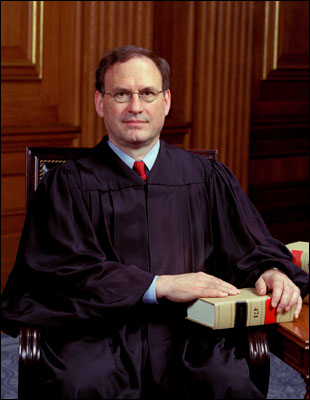
Justice John Stevens (pictured above), because the overwhelming squealing at his Florida home from his wife and three daughters "nearly deafened [him] even more than usual when they heard about the case;"

Justice Anthony Kennedy (above), who gave no official reason for his recusation (although rumor abounds that Kennedy balked at potentially being the swing vote in an "undead decision" that could "bury [his] reputation with the ladies");

Justice Stephen Breyer (above), apparently because he was sick of law students associating him solely with ice cream and couldn't bear the thought of being further associated with the "Vampyre" and the potential ramifications of being known simply as "The Honorable Count Chocula";

and Justice Clarence Thomas (above), because he was feeling grumpy the day of oral argument.

Writing for what was left of the majority, Chief Justice John Roberts (above) opined that "
Twilight, as a whole, appeals solely to the "prurient" interest, depicts and describes in a patently offensive way particular uncomfortable conduct prohibited by most states (necrophilia), and--when taken as a whole--lacks 'serious, literary, artistic, political [and] social value.'" After engaging in the
Miller analysis, the Chief Justice crafted a surprising new rule that, in theory, will only apply to teenage vampire romance novels--the so-called "Cullen Rule."
Citing the longstanding Supreme Court decision disallowing First Amendment protection of child pornography, the Chief Justice reasoned that, although 100 years old, Edward Cullen, the protagonist and lead romantic interest of the series, was trapped in the body of a 17-year old minor. "Thus," wrote the Chief Justice, "Bella, the novel's heroine, upon reaching the age of majority systematically and obscenely engaged in vampiric, yet statutorily-prohibited acts with Edward, the 17-year old, perfectly-figured
lolito."
Characterizing Bella Swan as both a "predator more vile than vampire" and a "dangerously ditzy criminal," the Chief Justice labeled her character "pristinely degrading to women, dependant, insipid, and, at the end, stupendously annoying."

Justice Samuel Alito (above), joined by Justice David Souter (not pictured), concurred in the majority's result, but not in its reasoning. Basing his opinion not in the obscenity doctrine, but in the unprotected category of speech known simply as "incitement," Justice Alito decried the series' "clear and present danger."
"The reaction this book has stirred amongst the populace of this nation has raised it to a level of danger beyond that posed by vampires and werewolves combined," Alito wrote. "I cannot presume to guess how many lives have been lost, how many families fractured, and how many young romances ruined by the publication of this monstrosity. The name 'Edward Cullen' may now be synonymous with imminent threat of unlawful activity. Sometimes, the clear and present danger presented by novels such as
Twilight rise to the level of shouting 'FIRE!' in a crowded theater."
After engaging in another 20 pages of empassioned analogy, Justice Alito ended his concurrence with this interesting, yet ultimately flawed speculation: "The imminent threat of yelling 'FIRE!' in a crowded theater, however, may be ignored by the reviewing court if in fact that theater is showing
Twilight. In this instance, fire may indeed be combatted with 'FIRE!'"

Justice Ruth Bader Ginsburg (above) penned the dissenting opinion. Perhaps hearkening back to her wild days at Harvard and Columbia (where she was known commonly as Ruth "Bomb Track" Bader), Justice Ginsburg summed up her reasoning succinctly: "Best. Books. Ever."

In a somewhat surprising twist, joining Justice Ginsburg in her dissent was none other than Justice Antonin Scalia (above, staring intently into your soul...), who "focused on the facts and original intent" of
Twilight and wound up writing a 30-page judicial review of the series, christening it at times as "a masterpiece of young adult fiction...eloquently written, superbly crafted" and "perfect for readers of all ages, creeds, sexes, and nationalities."
Diving into his all-too-familiar dissenter's rhetoric, Justice Scalia made "a passionate plea to vindicate Edward, that un-vivacious, oft-vexing, vixen of a vampire." Citing his long-time fascination with the undead, Justice Scalia at one point in the opinion admitted to "maintaining a library dedicated to the greats--from Stoker, to Rice, to...you guessed it, Meyer." Justice Scalia, clinging to his quirky, yet endearing penchent for self-referral in the third person, then reasoned that "If Scalia, as conservative a fellow as exists, could love and appreciate
Twilight, it obviously could not fail the first prong of the
Miller test. While Scalia is many things, prurient he is not." Legal scholars are already debating the viability of such a "Scalia Prurience" test.

With the future of
Twilight hanging in legal limbo, critics of the five-justice decision have already voiced their despair. Some protesters (see above) have adopted rhetorical mottos such as the poignant "If Cinderella gets her Prince Charming, where is my Edward?" and the agressive "Bite Me," presumably aimed at the Roberts, Alito, Souter triad. This voice represents no small group, either. According to one protester, more than "800 billion" copies of
Twilight have been sold worldwide. Countermajoritarians have teamed up with
Twilight fans and reportedly called on President-elect Obama to look into new Justices that will reverse the decision...

In the meantime, these self-proclaimed "Culleneers" have already adopted Justice Scalia (pictured above with protesters) as their own jurisprudential Edward, holding his opinion up as a "Standard of Truth, Justice, and Meyer." Perhaps sensing his own impending move from the Stuffy Bench to the Sexy Crypt, Scalia seemingly relished in the opportunity his dissent provided to whip out a jurisprudential stake and make a stab at what many view as the underpinnings of the majority's decision: male anxiety.
"Roberts, Alito, and Souter are, in the layman's term," Scalia writes, "sissy pants. If they were more like Edward, as Scalia is and continues to become as his
per se life winds down and his un-death begins, they would 'get more play.' This is a case not of obscenity, nor of incitement, nor of any danger; this is a case of the Honorable
Twilight Player Hater."
Justice Scalia closed his decision, and the opinion, with typical artistic flair. "Scalia, the Player, the Justice, the Jurisprudential Vampire, thus dissents...with a flourish of his cape and a flash of his mighty fangs. Mwa-ha-ha."
Today, as twilight settles in over the Potomac, fans of Edward Cullen and Justice Scalia can be seen emerging from their shelters and roving the streets of DC clad in black robes, neatly coifed hair, and plastic teeth. While the gears of Justice may have ground its press to a halt, in the minds and hearts of these true believers,
Twilight has not gone will never go alone into the dark.
--Bob Lawblah, Law Blog Senior Writer.